
The Story of St. Mark’s Antique Stole
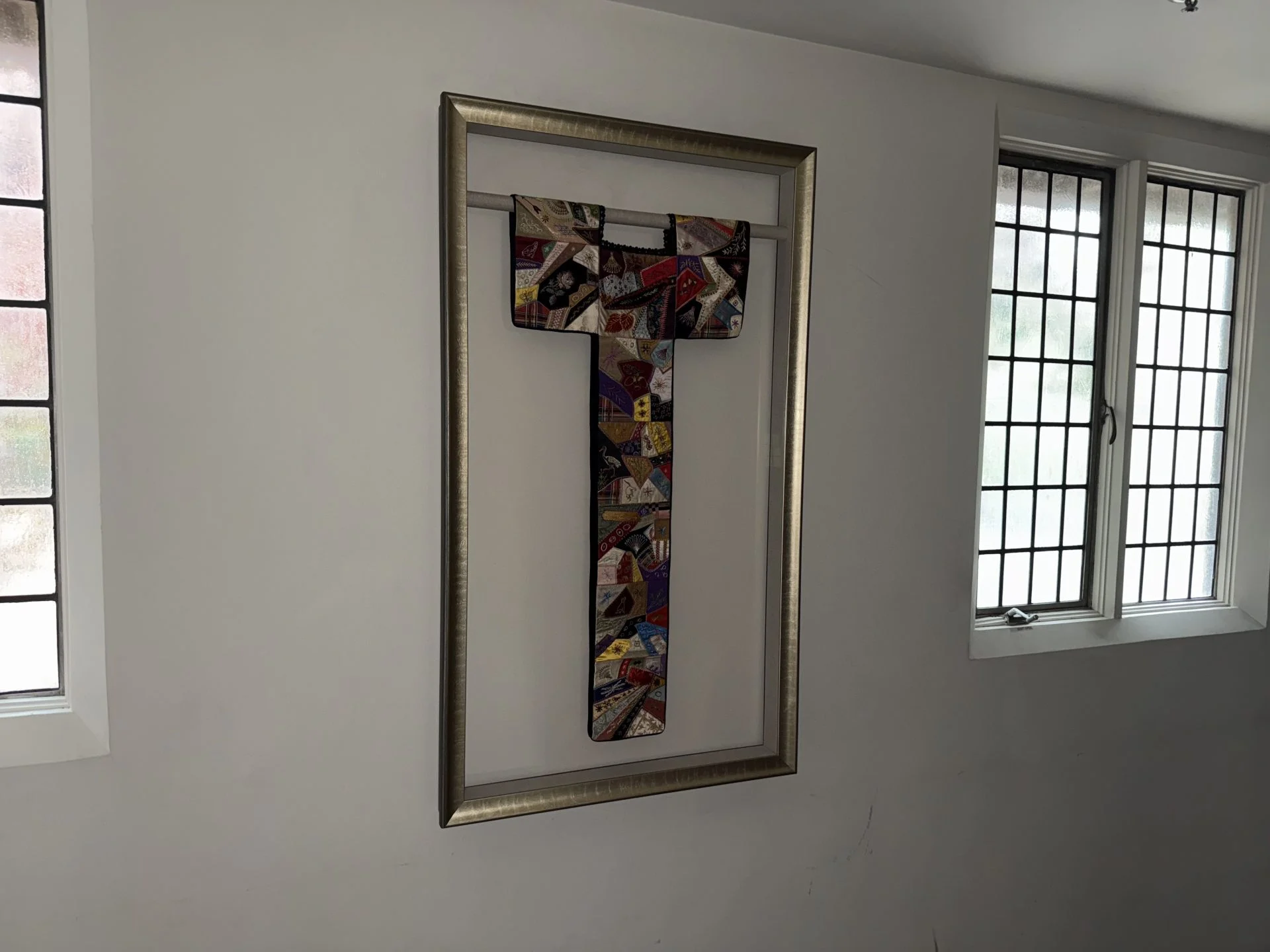
In 2025, St. Mark’s was blessed with the discovery and restoration of an antique stole, which is now on display in the Chapel of St. Mary Magdalene thanks to the efforts of parishioner Jane Piller-Wilson, who worked to uncover the stole’s history and get it framed and displayed for all to enjoy. Here is what Jane wrote about her work on the stole.
A TREASURE AND A MYSTERY: The story of St. Mark’s Antique Stole
Several months before his retirement, Father Matt handed me a treasure and a mystery. While going through church property in preparation for retirement, he discovered in the basement an unusual vestment. It was nestled in a shoe box and supported with tissue paper. Stitched in a crazy-quilt pattern from a wide array of silk fabrics, including velvet, it is finely embroidered with silk thread. The value of this textile wasn’t immediately apparent to Fr. Matt, but I knew something special had been given to me for safekeeping. Questions quickly came to mind of its value, the identity of its maker, and how it came to St. Mark’s to be left in the basement.
There is an understanding in the world of textiles that fabrics tell stories. After all, the words “text” and “textile” share the same root. Textiles reveal the science, technology, politics, economics, sociology, values and aesthetics of their era. What story was folded into the St. Mark’s stole?
A friend and fellow member of the Textile Arts Council of the de Young Museum suggested I contact Julie Silber. Julie is a local quilt expert, dealer, and curator of the Esprit Quilt Collection. I drove the stole to her studio in Berkeley to learn what she had to say. As the stole was laid on the studio table, her expression confirmed my intuition. It was very rare, she said, and made in the early 1880s. The quality of the workmanship and its perfect condition are what made it rare.
She was able to date the stole between 1880-1883 because the silk was unweighted. Weighting silk began in the mid-1880s. Although most fabric was sold by the yard, silk was sold by weight. To increase profits by increasing weight, silks were processed with salts containing lead, tin or other metals. Unfortunately, metals eventually destroy silk. To demonstrate this, Julie brought out a quilt made in the mid-1880s. As she tossed it over a wooden quilt “horse,” shattered fragments of silk floated through the air like butterflies. The St. Mark’s stole had avoided such a fate by only a couple of years. Julie mentioned she had clients who would be interested in the stole. She also wanted to follow its future. St. Mark’s clearly had a treasure.
A second opinion on the value of the stole came from Christopher Wilson-Tate, an antique quilt dealer in London. During a textile tour in the city, I took the opportunity to show Chris photos of the stole. He confirmed its quality and rarity, mentioning that he, too, had clients who would be eager to buy it. He placed its value higher than Julie had.
Although we don’t know her name or where she lived, it is safe to conclude a Victorian woman of means created the stole. She had to have had access to high quality silk fabric and thread. She was attuned to fashion. Crazy-quilting was in the forefront of women’s popular culture and was described by some as “crazy-work fever” and a “mania.” Victorian housewives were responsible for establishing their homes as a place of peace and shelter. Elegant and tasteful surroundings were thought to influence family members, enriching them spiritually as well as visually.
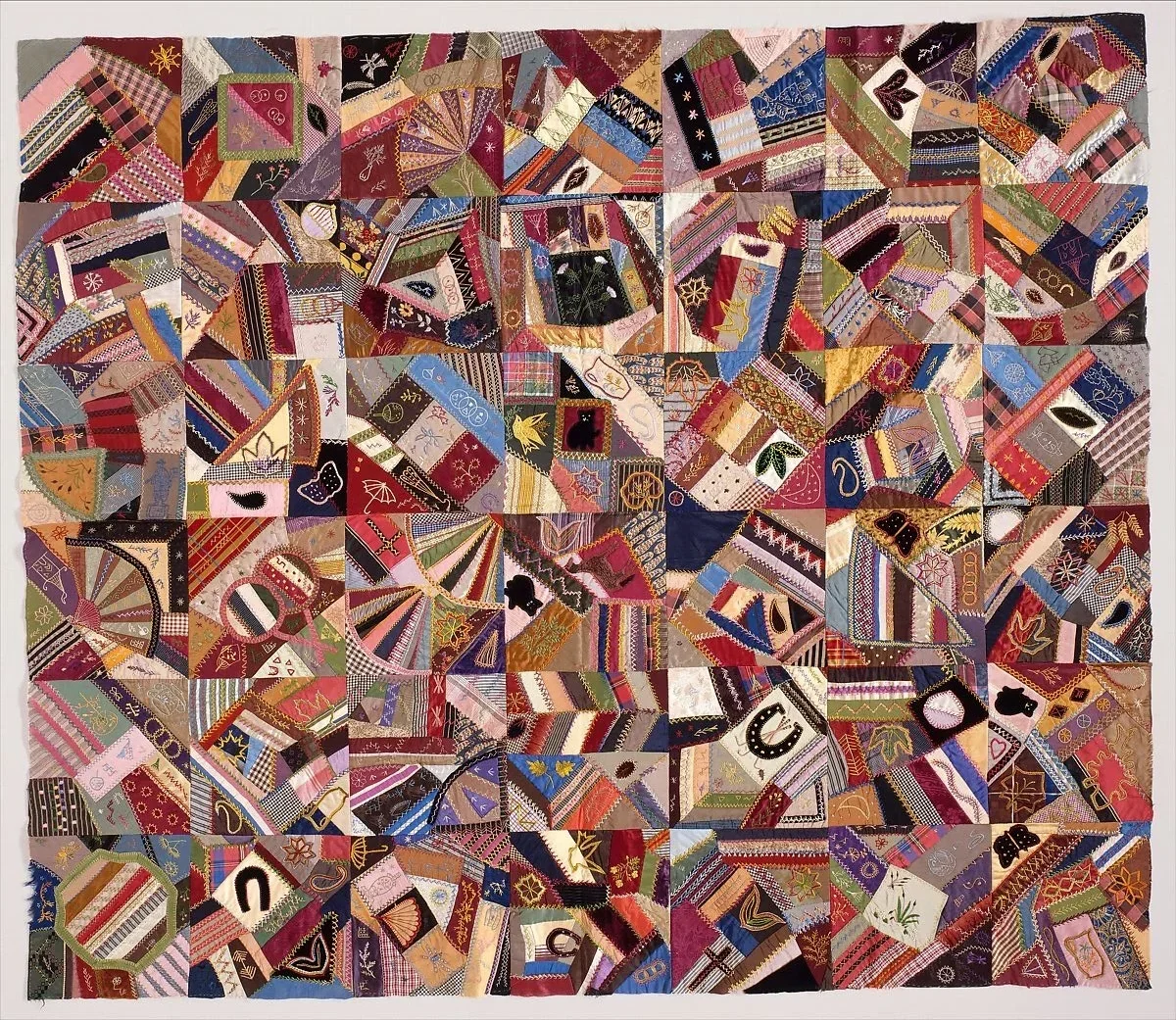
An American Made “Crazy Quilt” from 1885, from the Met Collection
Examination of the stole’s small even stitches reveal our Victorian embroiderer to be a perfectionist. Samples stashed at the bottom of the shoebox show how she worked to develop the scale of the stitches and size of the imagery. If the stitching in the finished stole wasn’t so consistent, it would be worth considering that it was created through a group effort.
The images she embroiders are not biblical in nature; they are copied from printed patterns offered in magazines like Harper’s Bazaar and Godey’s. Different from patchwork quilts, which were commonly used as bedcovers, crazy-quilts were meant to hang on the wall for decoration. Stitching the irregularly shaped pieces onto background fabric was an extra expense for crazy quilters. It is also a distinction from similar looking patchwork quilts in which the irregular patches were stitched to each other, not to background fabric.
Our embroiderer, for all her skill, was apparently not a seamstress or tailor. The only flaw of the stole—and it is significant—is that it ignores natural shoulder slope; the neckline juts straight out, refusing to conform to the human body. This major flaw is probably what saved it for our pleasure and appreciation. Being unwearable, it was safely stashed away from light and other environmental degradants until it was to be discovered, framed and displayed inside St. Mary Magdalene Chapel.
How and why the stole came to St. Mark’s remains a mystery. It is, after all, twice the age of our church. Although gifts such as stoles were given to individual priests for special occasions, and from one church to another, there doesn’t seem to be a record within St. Mark’s of its donation. Local newspapers usually reported gifts like this but have yet to be investigated.

Our beautiful stole is part of a long legacy of liturgical textiles. Here is a modern day quilted stole for the season of Lent from Quilted with Prayer and an Italian embroidered stole from the mid-1700s in the Met collection.
Also a mystery is how our anonymous Victorian embroiderer felt upon learning that after endless hours of gathering scraps, planning a design, and straining her back, fingers and eyes to make an object of beauty, it failed in its final purpose. I wish her to know that 150 years after its creation, her work is a blessing for our entire church community. For me, the stole is also a reminder that across time and space God uses what is imperfect to nourish our souls with joy and beauty.
Many thanks to all who have contributed advice, encouragement, and consent to the preservation, framing and display of St. Mark’s treasure.